
Few houseplants have made the jump from obscure collector item to mainstream decor staple as quickly as the Monstera Deliciosa Thai Constellation. A decade ago, a small rooted cutting could sell for hundreds of dollars among aroid enthusiasts. Today it sits on shelves at big-box garden centers, and its cream-speckled, galaxy-like foliage has become one of the most photographed houseplants on the market.
The species behind it, Monstera deliciosa, is already a familiar face in living rooms everywhere thanks to its dramatic split leaves, and the Royal Horticultural Society lists it as one of the most popular and widely available houseplants of its kind. The Thai Constellation, however, plays by slightly different rules. Its cream leaf tissue carries no chlorophyll at all, which means the plant is quite literally working with less fuel than an ordinary green Monstera. That single biological fact is the root cause of nearly every care challenge this cultivar presents, from its unhurried growth rate to its low tolerance for wet feet and dim corners.
None of this makes the plant difficult so much as specific. Understand how light, moisture, humidity, and feeding interact, and keeping it alive stops being a guessing game and starts producing the oversized, deeply fenestrated leaves that make it worth the fuss.
What Is Monstera Deliciosa ‘Thai Constellation’?
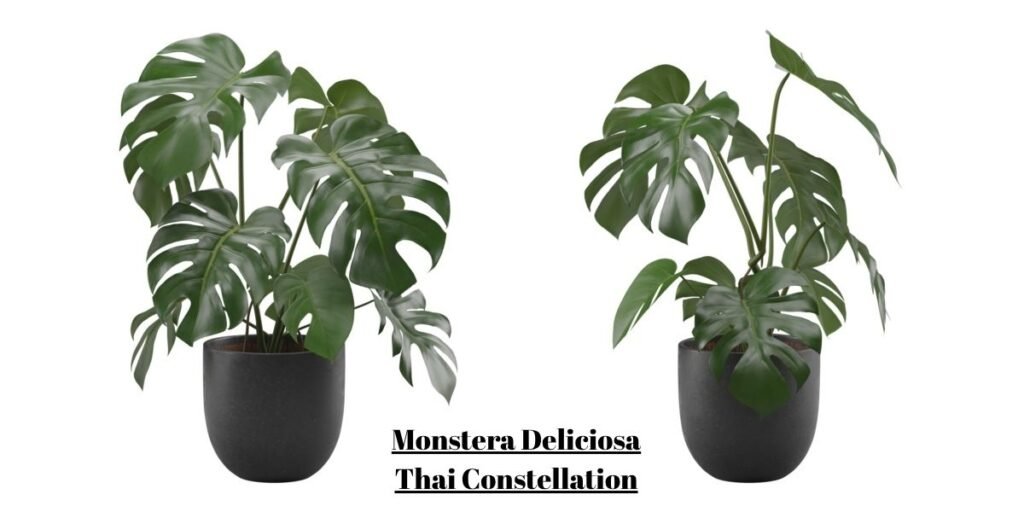
Thai Constellation is a variegated cultivar of the common split-leaf Monstera, easily identified by the splatter-style pattern of cream and warm butter-yellow that runs across its otherwise deep green leaves.
It is worth being precise about how it differs from the plant it is most often confused with, Monstera Albo. The white patches on Albo arise from a spontaneous chimeral mutation, a genetic accident that occurs unpredictably and can appear or vanish across generations of cuttings. Thai Constellation has a very different backstory. Commercial growers who have documented the cultivar’s history describe it as a mutation identified and then deliberately multiplied through tissue culture in a laboratory in Thailand, which is exactly how the plant picked up its name. Costa Farms, one of the largest commercial growers to bring the plant to market at scale, refers to it as the queen of houseplants and confirms that, unlike Albo, its variegation is stable rather than prone to reverting.
That stability is the plant’s biggest selling point. Because the variegation pattern is fixed at the cellular level rather than existing as a patchwork of unstable cell lines, a Thai Constellation you buy today should keep that same speckled look for the rest of its life, without the surprise reversions to solid green that frustrate Albo owners.
The tradeoff is speed. Costa Farms is upfront about this in its own grower notes, explaining that the plant’s slow growth comes directly from the fact that its creamy-white variegation makes it a slower grower because the leaves have less chlorophyll. Every cream fleck on a leaf is, in effect, dead weight the plant still has to grow, support, and hydrate without getting any energy back from it.
Given time and good conditions, though, this is not a small plant. Costa Farms notes a well-cared-for Thai Constellation can grow more than 6 feet tall and wide indoors, with individual leaves eventually stretching beyond 2 feet across and developing the deep splits and interior holes, known as fenestrations, that collectors prize.
How to Grow Monstera Thai Constellation
Give It Bright Light Without Scorching the Variegated Leaves
If there is one variable that separates a thriving Thai Constellation from a struggling one, it is light. Because the cream sections of the leaf cannot photosynthesize, whatever green tissue remains has to carry the entire energy load for the plant, and it can only do that with a genuinely bright spot to work with.
Aim for bright, indirect light for roughly 8 to 10 hours a day. An east-facing window is close to ideal, since it delivers strong morning sun without the harsher, heat-loaded intensity that builds up by midday. For the broader Monstera deliciosa species, the RHS recommends bright, indirect light with moderate to high humidity as standard cultivation practice, a guideline that applies just as much to variegated cultivars as it does to the plain green form.
A west or south-facing window also works well, provided the plant sits a few feet back from bare glass or is filtered through a sheer curtain. Direct, unfiltered midday sun through a window scorches the pale sections quickly, turning them translucent before they crisp into dead brown patches that never recover. Once that tissue burns, it stays damaged.
Go too far in the other direction and a different set of problems shows up. Too little light stalls growth outright, new leaves come in smaller, and fenestrations stop forming altogether. Under-lit Thai Constellations often abandon their cream sections first, shedding the tissue that costs energy without returning any.
If your space runs dim, especially through the shorter days of winter, a full-spectrum LED grow light running 12 to 14 hours a day, positioned around 18 to 24 inches above the canopy, closes that gap without risking light burn.
Water When the Soil Has Partly Dried
Rigid watering schedules tend to fail this plant, because indoor humidity, temperature, and light shift too much across a year for a fixed calendar to make sense. Checking the soil directly works far better than counting days.
Feel the top 2 to 3 inches of the potting mix with a finger or a moisture meter before adding water. That upper layer should be fully dry, while the lower root zone still holds a trace of coolness. Costa Farms care instructions put it slightly differently but land on the same principle, advising growers to water once the top half or so of the potting mix starts to dry to the touch, since the white variegation is prone to browning if the plant is allowed to dry out too aggressively.
When you do water, saturate the mix thoroughly until water runs freely from the drainage holes. That flushes out accumulated fertilizer salts and ensures the entire root mass gets hydrated, not just the top inch.
Never let the pot sit in standing water inside a saucer or decorative cachepot. Stagnant water starves the lower roots of oxygen and creates exactly the conditions root-rot pathogens thrive in. The NC State Extension Gardener Plant Toolbox lists overwatering leading to root rot as one of the most common problems affecting Monstera deliciosa, and this cultivar is generally regarded by growers as even more sensitive to it, since much of the original tissue-cultured stock has shown a documented susceptibility to Phytophthora fungal pathogens.
Expect watering frequency to shift with the seasons. In warm, bright summer conditions, that usually works out to every 7 to 10 days. Once temperatures drop and light fades in winter, the same plant might only need water every 2 to 3 weeks. Let the soil, not the calendar, make that call.
Use an Airy, Fast-Draining Aroid Mix
Dense, bagged potting soil holds far more moisture than an epiphytic aroid’s roots are built to tolerate. In the wild, Monstera roots grow through loose leaf litter and bark crevices rather than compacted earth, and they need that same access to oxygen indoors.
A dependable aroid substrate blend looks like this:
- 1 part coarse potting soil or coco coir, for base structure
- 2 parts orchid bark, to create large air pockets around the roots
- 1 part coarse perlite or pumice, for extra aeration
- 1 part horticultural charcoal, which helps sweeten the mix and suppress bacterial buildup
Drainage holes are non-negotiable here. Whether you choose terracotta, unglazed ceramic, or plastic nursery pots, water needs somewhere to go. A chunky mix means watering a bit more often since it holds less moisture overall, but it removes root rot from the list of everyday worries and gives the plant’s aerial roots room to properly anchor into the container.
Keep the Plant Warm and Give It Enough Humidity
As a plant native to warm, humid forest understories, Thai Constellation does best with indoor temperatures held between 65°F and 85°F. Keep it clear of cold window drafts in winter, exterior doors, air-conditioning vents, and radiators, all of which cause sudden localized stress the plant handles poorly.
Humidity is where sources can sound like they disagree, so it helps to be specific. Costa Farms states the plant is happiest in relative humidity above roughly 55%, though it tolerates 40% to 55%, especially when watered properly. The RHS takes a broadly similar stance for the species, calling for moderate to high humidity as part of standard indoor cultivation.
In practice, a plant at 40% humidity in a centrally heated home will survive and look fine, but one kept closer to 55% to 65% will noticeably outgrow it, with far fewer of the crisp brown edges that plague specimens kept in dry air. Low humidity hits the cream sections hardest, since they have no chlorophyll reserves to buffer moisture loss, so browning along the pale edges is usually the first visible symptom of dry air.
A dedicated cool-mist humidifier placed nearby gives the most stable boost. Grouping houseplants together also raises humidity naturally, since transpiring plants release moisture into the surrounding air.
Skip the handheld misting bottle as a humidity strategy. It does not meaningfully raise room humidity, and it leaves standing water on the leaf surface, an open invitation for fungal leaf-spot problems.
Feed During Active Growth
During spring and summer, when the plant is metabolically active and building new tissue, feed it a balanced liquid houseplant fertilizer (something close to a 20-20-20 ratio) or a dedicated aroid formula, diluted to half strength so you do not burn the root hairs.
Apply that diluted feed once every four weeks, and always after a normal watering session rather than on dry soil, since fertilizing bone-dry substrate can scorch fragile roots almost immediately.
As days shorten in autumn and growth naturally slows, cut back or pause feeding entirely. Unused nutrients simply build up in the soil during dormancy as excess mineral salts rather than being absorbed by the plant. More fertilizer does not translate into faster growth or more dramatic variegation, it just raises the risk of burnt tips and yellowing leaf margins from that salt buildup.
Give Thai Constellation Something to Climb
In its native range, Monstera deliciosa is a hemiepiphyte, meaning it starts life rooted in the forest floor and then climbs tree trunks using thick aerial roots to work its way up toward the canopy. Indoors, giving the plant a genuine vertical support to replicate that behavior is one of the most underrated things you can do for leaf size.
A sphagnum moss pole, coir pole, or wooden trellis all work well. As the stem grows, loosely secure it to the support with soft plant tape or velcro ties, keeping the aerial root nodes in direct contact with the pole’s surface. A consistently damp moss pole lets those aerial roots colonize the moss to pull up supplemental water and nutrients, which signals to the plant that it is stable enough to invest energy into larger, more heavily fenestrated leaves.
A plain bamboo stake will hold a heavy stem upright, but it does little for leaf maturation, since there is no medium for the aerial roots to actually grow into. A true climbing support is what triggers the jump from small juvenile leaves to the wide, deeply split foliage this cultivar is known for.
How to Keep Thai Constellation Growing Strongly
Thai Constellation grows more slowly than a standard green Monstera by design, simply because a large share of each leaf is not generating any energy for the plant. Expecting a new leaf every couple of weeks, the way you might with a green deliciosa, will only set you up for disappointment.
A healthy new leaf emerges from the petiole as a tightly rolled, pale green spear, unfurling over several days and showing pale cream or light yellow patches before the tissue firms up into its mature coloring.
To reliably push toward large, deeply fenestrated leaves, keep these four factors dialed in together, since none of them fully make up for a shortfall in the others:
- Maximum bright indirect light, never direct midday sun
- A damp, nutrient-supporting climbing pole
- An airy, chunky potting mix that keeps roots oxygenated
- Warm temperatures paired with elevated humidity
If growth stalls completely during what should be an active spring or summer window, treat that as the plant flagging a problem rather than simply resting. Check for a root-bound pot, insufficient light, or compacted soil that has cut off oxygen to the roots.
Slow growth on its own is not a red flag. As long as existing leaves stay firm, richly colored, and free of spreading brown or black spotting, your plant is simply pacing itself the way this cultivar naturally does.
What to Do When Thai Constellation Leaves Turn Yellow or Brown
Yellow Leaves
Yellowing is a broad, nonspecific symptom, and it is worth investigating before reacting to it.
Overwatering combined with poor drainage is the most common cause. Waterlogged soil suffocates roots, and decaying roots can no longer support the leaves connected to them, so the lower, older foliage usually yellows first.
Insufficient light produces a similar effect through a different mechanism. The plant essentially triages, shedding older leaves it can no longer afford to maintain so it can redirect limited energy toward new growth.
It is also worth remembering that older leaves near the base of the stem naturally yellow and drop as part of a completely normal life cycle. If a single lower leaf yellows over the course of several months while new growth continues to look strong, there is genuinely nothing to worry about. Check soil moisture, root condition, and light placement before making any drastic changes to your routine.
Brown Edges and Tips
Crisp, papery brown edges along the leaf margin almost always point back to dry air or inconsistent watering.
When ambient humidity drops below roughly 30% to 40%, the plant loses moisture through its leaves faster than the roots can replace it, and the outermost tissue dries out first since it sits furthest from the water source.
Irregular watering, letting the soil go bone dry and then drenching it, shocks the root system in a way that shows up on the leaf tips days later. Excess fertilizer salt buildup produces the same symptom through a different mechanism, so if tip burn persists despite good watering and humidity, flush the mix thoroughly with distilled water to clear accumulated salts.
Brown or Bleached Patches on the Cream Sections
The white and cream patches carry no protective chlorophyll, which leaves them uniquely vulnerable to both light and heat stress in a way the green tissue simply is not.
Direct sunlight acts almost like a magnifying glass on these sections, bleaching them white before the cells die off and crisp into thin brown scars. Sudden cold drafts from an AC vent or a drafty winter window cause localized cell death that shows up as dark brown or black patches rather than a uniform crisping. And any physical bumping or handling of a leaf while it is still unfurling will leave a permanent scar once that leaf fully expands and hardens off.
How to Propagate Monstera Thai Constellation
Propagating this cultivar is genuinely rewarding, but there is one rule that overrides everything else: every cutting must include a healthy stem node. A leaf cut with only a bare petiole will happily root in water, but it will never push a new growth shoot, because the genetic instructions for producing new stem tissue live exclusively in the node itself.
To take a viable cutting:
- Locate a mature stem section with at least one healthy node and one or two attached leaves.
- Using a sterilized blade, cut through the stem about 1 inch below the node.
- Let the cut end air-dry for 30 to 60 minutes until a callus forms over the wound.
- Place the cutting in clean water, damp sphagnum moss, or coarse perlite, keeping the node submerged or surrounded by the medium while the leaf blade itself stays dry.
- Keep the cutting warm and in bright indirect light. New roots typically emerge from the node within 3 to 6 weeks.
- Once roots reach 3 to 4 inches with visible lateral branching, pot the cutting into a proper airy aroid mix.
One detail beginners often overlook: choose your cutting from a stem section with balanced, marbled variegation. A cutting from a solid green section tends to produce a low-variegation plant, while an almost entirely cream section produces a fragile shoot that often struggles to survive, since it lacks the chlorophyll-bearing tissue needed to fuel its own establishment.
When to Repot a Thai Constellation
This cultivar actually prefers staying a little snug in its pot. Repotting too often, or jumping straight into an oversized container, increases the volume of wet soil around the roots and raises the risk of root rot considerably.
Watch for these clear signs that a repot is genuinely overdue:
- Thick roots visibly emerging from the drainage holes
- Roots circling tightly around the inside edge of the pot
- Water running straight through without being absorbed
- Growth that has stalled completely during spring or summer
Move up to a pot only about 2 inches wider in diameter than the current one. Gently ease the plant free, loosen any tightly bound outer roots, and settle it into fresh aroid mix at the same soil depth as before to avoid stem rot. Time the repot for early spring or mid-summer, when the plant is actively growing and can recover from root disturbance quickly.
Thai Constellation vs. Monstera Albo
| Feature | Monstera Thai Constellation | Monstera Albo |
| Variegation Color | Cream to warm butter-yellow | Pure bright white |
| Pattern Type | Fine speckles, splatters, and marbled patches | Large blocky splashes, half-moon sectors |
| Variegation Stability | Extremely stable, developed via lab tissue culture | Unstable, a naturally occurring chimera |
| Reversion Risk | Almost none | High risk of reverting to solid green or pure white |
| Growth Rate | Moderate and fairly consistent | Slower, delicate, and unpredictable |
| Availability & Price | Widely available, roughly $30 to $100 | Rare, often $100 to $300+ |
The practical takeaway is straightforward. Thai Constellation gives you a dependable, stable pattern you can count on for the life of the plant. Monstera Albo offers a more dramatic, high-contrast look, but you are accepting a real, ongoing risk of genetic reversion as part of that trade.
Pests, Root Problems, and Other Issues to Watch For
The broad leaves and warm, humid conditions this plant prefers also attract several common indoor pests. The NC State Extension Plant Toolbox flags spider mites, mealybugs, aphids, whiteflies, and scale insects as the pests most likely to show up on Monstera deliciosa, alongside overwatering as the leading cause of root rot.
- Spider mites thrive in dry conditions and live on leaf undersides, sucking sap and leaving fine webbing along with yellow stippling.
- Mealybugs and scale insects attach to stems and petioles, showing up as small brown bumps or cottony white clusters. A cotton swab dipped in rubbing alcohol removes light infestations by hand.
- Aphids and whiteflies cluster on new growth and the undersides of leaves, causing distorted or sticky foliage as they feed. Insecticidal soap applied directly to affected areas usually brings both under control within a couple of applications.
Root rot remains the most dangerous non-pest threat to this cultivar, given its documented sensitivity. If you notice yellowing leaves paired with soft, mushy stem tissue near the soil line, unpot the plant immediately, trim away dead black roots with a sterilized blade, and repot into fresh, dry aroid mix. Checking under leaf joints periodically for early pest activity is far easier than treating an infestation once it is already established on stressed foliage.
Is Monstera Thai Constellation Safe Around Pets?
No, and this is worth taking seriously rather than treating as fine print. Like all Monstera deliciosa varieties, Thai Constellation contains insoluble calcium oxalate crystals distributed throughout its stems and leaves. According to the ASPCA official plant toxicity database, Monstera deliciosa is toxic to both dogs and cats, and ingestion typically causes oral irritation, intense burning of the mouth and tongue, excessive drooling, vomiting, and difficulty swallowing as the microscopic crystals embed in soft tissue. The RHS similarly lists Monstera deliciosa among plants that are harmful if eaten and recommends wearing gloves when handling it.
If you suspect a pet has chewed on or swallowed part of the plant, contact the ASPCA Animal Poison Control Center at (888) 426-4435 or your veterinarian right away.
The sap can also irritate skin and eyes during pruning or repotting, so wearing gloves while taking cuttings is a sensible habit rather than an overcautious one. Position the plant on elevated stands or tall furniture, well out of reach of curious pets and small children.
Frequently Asked Questions About Monstera Thai Constellation
How much light does a Thai Constellation Monstera need?
Roughly 8 to 10 hours of bright, indirect light daily, ideally near an east or south-facing window positioned a few feet back from direct glass.
How often should you water a Thai Constellation?
Water once the top 2 to 3 inches of soil feel dry, typically every 7 to 10 days in summer and every 2 to 3 weeks in winter, depending on light and temperature.
Why is my Thai Constellation growing slowly?
The cream sections carry no chlorophyll, which limits overall energy production. Low light, cool temperatures, and the absence of a climbing support all compound and slow development further.
How do you get larger leaves on a Thai Constellation?
Secure the main stem to a damp sphagnum moss pole, keep temperatures above 70°F, and maintain strong, consistent indirect light.
Does the Thai Constellation need a moss pole?
It is not strictly required for survival, but a moss pole provides the structural cue and moisture source that encourages noticeably larger leaves with deeper fenestrations than an unsupported plant will produce.
Why are the white parts of my Thai Constellation turning brown?
Brown patches on cream tissue usually trace back to direct sun scorch, humidity below 40%, cold drafts, or root damage from overwatering. That tissue has no chlorophyll to buffer stress, so it shows damage before the green sections do.