
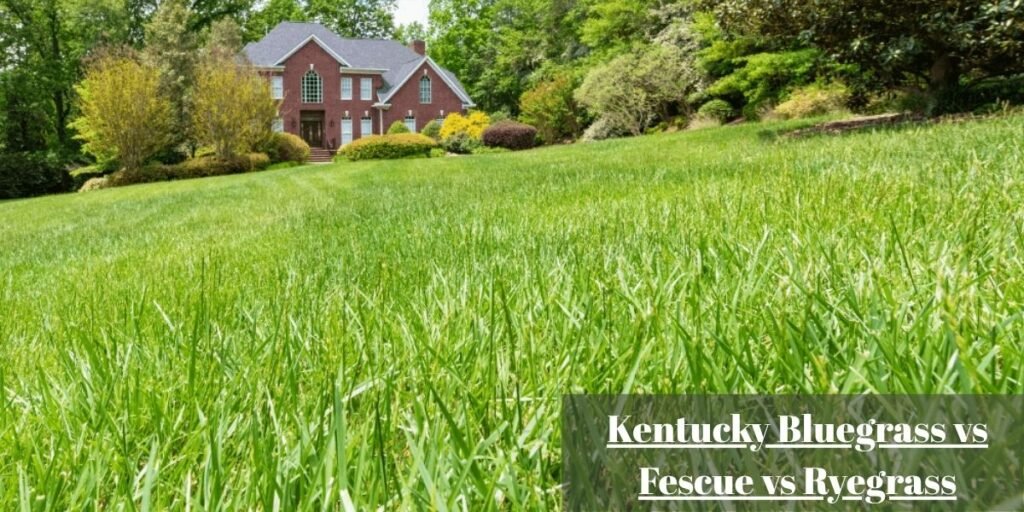
Choosing a cool-season lawn grass is one of those decisions that quietly shapes the next ten years of your yard. Pick a species that doesn’t suit your climate, soil, or schedule, and you end up paying for it through weed pressure, high water bills, recurring disease, and overseeding every fall.
Kentucky bluegrass, tall fescue, and perennial ryegrass are the three main cool-season turfgrasses used across northern and transition-zone lawns. Each one differs in how it grows, how deep it roots, how fast it germinates, and how it handles heat, shade, and foot traffic. Knowing those differences up front is the cheapest way to avoid a failed lawn.
Kentucky Bluegrass vs Fescue vs Ryegrass: Key Differences
Kentucky bluegrass gives you a dense, dark green lawn with excellent cold hardiness. It also repairs itself through underground stems called rhizomes. Tall fescue builds a deep root system, which is why it holds up better in heat and drought. Perennial ryegrass is the sprinter of the group. The Oregon State University Extension guide on lawn grasses puts its germination at about 5 to 7 days under ideal conditions, while noting that Kentucky bluegrass can take 21 days or more.
The table below summarizes how each grass performs. Germination figures follow published extension guidance, and the remaining traits reflect typical turf performance.
| Trait | Kentucky Bluegrass | Tall Fescue | Perennial Ryegrass |
| Germination time | 10 to 21+ days | 7 to 14 days | 5 to 7 days |
| Establishment speed | Slow, 2 to 3 months | Moderate, 4 to 6 weeks | Fast, 1 to 3 weeks |
| Heat and drought tolerance | Moderate, goes dormant early | High, deep roots reach stored water | Low to moderate, prone to summer stress |
| Shade tolerance | Poor to moderate | Moderate to high | Fair to moderate |
| Foot traffic | High wear recovery | High wear tolerance | Very high wear tolerance |
| Growth habit | Rhizomatous, spreads underground | Bunch-type | Bunch-type |
| Leaf texture | Fine to medium | Medium to coarse, turf-types are finer | Fine to medium |
| Water needs | High, about 1.5 inches per week | Moderate, about 1 inch per week | High, about 1.25 to 1.5 inches per week |
| Best primary use | Northern lawns, sports fields | Low-water lawns, transition zone, slopes | Quick repair, winter overseeding, high-wear areas |
Germination ranges differ a little between sources because soil temperature, moisture, and seed quality all shift the clock. The University of Kentucky Cooperative Extension lists tall fescue at 7 to 10 days and Kentucky bluegrass at 10 to 21 days. Cornell Cooperative Extension of Nassau County reports turf-type tall fescue emerging in 10 to 14 days. Plan around the longer end of each range if you are seeding in cool soil.
Kentucky Bluegrass vs Tall Fescue vs Perennial Ryegrass
Each species earns its place for a different reason, and each has a weakness worth knowing before you buy seed.
Kentucky Bluegrass
Kentucky bluegrass (Poa pratensis) has boat-shaped leaf tips and a rich blue-green color that many people picture when they think of a classic lawn. Its signature trait is the rhizome, an underground stem that runs sideways through the top few inches of soil and sends up new shoots. That is how a bluegrass lawn slowly fills in thin spots without any help from you.
The trade-off is patience and upkeep. Bluegrass is slow from seed, and two to four weeks of bare soil before you see green is normal in spring or fall when soil temperatures sit around 50°F to 65°F. Don’t reseed at day fifteen just because nothing has appeared yet, because that only wastes seed.
During hot, dry stretches without irrigation, bluegrass protects its crown by going dormant and turning brown. It usually greens back up when moisture returns, but a lawn that stays dormant for too long begins to thin.
Bluegrass does best in northern regions with cool summers, full sun, and deep, well-drained, fertile soil. It also asks for more fertilizer than the other two species, commonly 3 to 4 pounds of nitrogen per 1,000 square feet each year, to stay dense and resist diseases such as rust and dollar spot. If you skip feeding, thinner turf is the first thing you will notice, followed by weeds.
Tall Fescue
Tall fescue (Festuca arundinacea) is the workhorse of the transition zone, where summers run too hot for most northern grasses and winters are too cold for warm-season species. Older agricultural types like K-31 are coarse and clumpy. Modern turf-type tall fescues (TTTF) have finer blades, darker color, and much better density, so they look far more like a true lawn.
Its biggest advantage is below ground. Tall fescue roots can reach well beyond the depth of bluegrass roots in uncompacted soil. That lets the plant pull moisture from deep layers long after the surface has dried out, which is why it stays green through moderate drought with less watering.
There is one limitation to plan for. Tall fescue grows in bunches and has no real rhizomes, so grub damage, disease patches, or deep scarring do not heal on their own. Autumn overseeding is the standard fix for thin or bare spots, and it is best done every year or two so the lawn stays thick.
The University of Kentucky Extension adds one practical caution that many seed labels ignore. Because of differences in leaf texture and growth, tall fescue should not be mixed with perennial ryegrass or fine fescue. Overseeding turf-type tall fescue into a weak bluegrass lawn, on the other hand, is acceptable and often improves it.
Perennial Ryegrass
Perennial ryegrass (Lolium perenne) is known for fast emergence and a glossy, bright green leaf underside. In moist soil around 60°F, seedlings can break the surface in about a week. That speed makes it valuable for patch repair, erosion control, and getting cover on bare ground before heavy rain.
It also stands up well to wear. The stiff, fibrous leaves tolerate foot traffic, which is why ryegrass shows up on athletic fields and in winter overseeding programs. Its quick canopy helps crowd out weed seedlings while slower grasses are still getting started.
The weaknesses are real, though. Ryegrass grows in bunches and cannot spread sideways into damaged areas. It handles extreme heat and hard cold poorly, and it can suffer from pythium blight and crown rust during hot, humid weather. The University of Kentucky guidance notes that when seeded alone, perennial ryegrass may not survive summer stress, and that it is generally not recommended as a primary lawn grass in Kentucky.
A better use is as a small part of a blend. The same guide recommends about a quarter pound of perennial ryegrass per 1,000 square feet alongside 1¾ pounds of Kentucky bluegrass, which gives you quick cover without letting ryegrass dominate the stand.
Which Grass Is Best for Your Lawn Conditions?
The right species depends on what your yard actually delivers in summer heat, sunlight, and daily use. Match the grass to those conditions first, and the maintenance usually takes care of itself.
Heat and Drought Tolerance
Tall fescue is the strongest performer in summer heat. Its deep root mass reaches water that bluegrass and ryegrass simply cannot access, so it can stay green and keep growing when air temperatures climb past 85°F. Kentucky bluegrass roots concentrate in the top 6 to 12 inches of soil, which leaves the plant dependent on regular irrigation.
Bluegrass copes with drought by shutting down. The leaves brown off, but the crowns stay alive, and a dormant lawn can typically recover after 3 to 4 weeks without water. Past that window, plant loss becomes a real risk, so a light watering every couple of weeks is worth the effort during long dry spells.
Perennial ryegrass has neither advantage. It lacks the deep roots of fescue and the dependable dormancy of bluegrass, so a prolonged heat wave on dry soil can kill it outright. That is the main reason it works best as a supporting species and not as a stand-alone lawn in hot climates.
Shade and Sunlight
Kentucky bluegrass performs best with 6 or more hours of direct sun each day. In shade, the blades thin out, density drops, and powdery mildew moves in quickly. Many lawns that look weak under trees are bluegrass lawns planted in the wrong spot.
Tall fescue tolerates moderate shade better than bluegrass or ryegrass, and Oregon State describes it as suitable for lawns from full sun to shade. Heavy shade is a different story. Under dense tree canopies, fine fescues such as creeping red and chewings fescue are the better choice, because almost no cool-season turf holds up when direct light drops to around three hours a day. Cornell’s Nassau County program reflects this by listing a shade-oriented blend built mostly on fine fescue with a smaller share of perennial ryegrass and Kentucky bluegrass.
Foot Traffic and Lawn Recovery
Foot traffic is easy to misjudge because two separate qualities are involved. Wear tolerance is how well a grass resists damage in the first place. Wear recovery is how well it fills in after damage happens.
Perennial ryegrass and tall fescue both have high wear tolerance because their tough leaf tissue resists tearing under active play. The catch is that neither can spread. When heavy use wears a patch down to bare dirt, those grasses cannot grow back into it without new seed.
Kentucky bluegrass is only moderately tolerant at first, but its rhizomes give it the best recovery of the three. Over several weeks, underground stems push into worn areas and send up new shoots, so the lawn closes its own gaps. For a family yard with kids and pets, that self-repair often matters more than raw toughness.
Should You Mix Kentucky Bluegrass, Fescue, and Ryegrass?
Blends make sense because a lawn made of several grasses is less likely to fail all at once. If one disease or pest hits a single species, the others keep the lawn looking intact. A pure Kentucky bluegrass stand struck by summer patch, for example, can suffer widespread dieback, while a blend limits the damage.
That said, not every combination works, and this is where many seed bags mislead buyers. The University of Kentucky Extension recommends keeping tall fescue separate from perennial ryegrass and fine fescue, because growth rate and leaf texture differences produce an uneven, patchy surface. A single mix of all three species is therefore a weaker idea than the original rule of thumb suggests.
These pairings are the ones that hold up in practice:
- Kentucky bluegrass with perennial ryegrass: This is the classic northern blend. Kentucky Extension suggests roughly a quarter pound of ryegrass per 1,000 square feet with 1¾ pounds of bluegrass, and Cornell’s Nassau County program lists a blend of about 65% bluegrass and 15% perennial ryegrass. The ryegrass germinates first and protects the slow bluegrass.
- Turf-type tall fescue with a little Kentucky bluegrass: This is a common transition-zone approach. The fescue supplies depth and heat tolerance, and the bluegrass fills small bare spots through its rhizomes.
- Fine fescue blends for shade: Use these when mature trees limit sunlight, and pair them with other shade-adapted species rather than tall fescue.
Cultivar choice matters just as much as species. Mixing a coarse pasture-type fescue like K-31 with fine bluegrass creates a lumpy, two-tone lawn. Choose turf-type varieties with similar blade width and growth rate, and read the seed tag for the actual cultivar names and the percent of weed seed and inert matter.
Which Grass Is Easiest to Maintain?
Maintenance comes down to water, fertilizer, and equipment, and the three grasses ask for very different amounts of each.
Kentucky bluegrass demands the most. To keep its density and color through summer it needs about 1 to 1.5 inches of water per week and three to four fertilizer applications each year. It also builds up thatch, a layer of dead stems and roots at the soil surface, which usually calls for dethatching every 2 to 3 years. Skip that step and water and fertilizer struggle to reach the root zone.
Tall fescue is the easiest once it is established. Its deep roots cut summer irrigation noticeably, and many lawns do fine on 0.5 to 1 inch of water every 10 to 14 days during dry periods. It needs less nitrogen, around 1 to 2 pounds per 1,000 square feet annually, and it produces very little thatch because of its bunching habit.
Perennial ryegrass needs steady moisture and regular feeding, but its unusual challenge is mowing. Its fibrous leaves tear when the mower blade is dull, leaving ragged, pale brown tips across the whole lawn after a cut. Sharpening the blade at the start of each season, and again midseason on larger lawns, solves most of the problem.
Which Grass Should You Choose?
Your climate, sunlight, and tolerance for upkeep should drive the final call. These matches cover the most common situations.
- Kentucky bluegrass: Best for northern climates with full sun, an irrigation system, and a goal of a dense, dark, self-repairing lawn.
- Turf-type tall fescue: Best for the transition zone, mixed sun and shade, lower summer water bills, and a lawn that tolerates heat and wear.
- Perennial ryegrass: Best for fast soil cover, thin-lawn overseeding before winter, or quick repair of high-traffic spots, ideally as part of a blend.
- Fine fescue: Best for yards dominated by mature trees where direct sun is limited.
- A seed blend: Best for yards with changing microclimates, uneven light, or a desire for built-in protection against disease.
If you are still undecided, a useful rule is to choose for your hardest condition and not your average one. A lawn lives or dies in its worst month, so base the decision on your hottest summer weeks or your shadiest corner.
Frequently Asked Questions
Is Kentucky Bluegrass Better Than Tall Fescue?
Neither is better in every situation, and the right pick depends on climate and how much upkeep you will do. Kentucky bluegrass offers greater density, richer color, and natural self-repair in cool northern regions where you can irrigate and fertilize regularly. Tall fescue does better in warmer transition climates, with deeper roots, lower water needs, and stronger heat tolerance.
Does Kentucky Bluegrass Spread Into Ryegrass?
Yes, over time it does. Because perennial ryegrass grows in bunches and cannot spread sideways, bluegrass rhizomes gradually move into the bare space between ryegrass clumps and increase the overall density of the lawn. That is the reason the two grasses pair so well in blends.
Which Grass Seed Germinates the Fastest?
Perennial ryegrass wins, usually emerging in 5 to 7 days under good conditions according to Oregon State Extension. Tall fescue generally needs 7 to 14 days, and Kentucky bluegrass can take 10 to 21 days or longer. Warm, evenly moist soil shortens every one of these timelines, while cold or dry soil stretches them.
Can You Mix Kentucky Bluegrass With Tall Fescue?
Yes, as long as you use turf-type tall fescue. Pairing it with a smaller share of Kentucky bluegrass is common in transition-zone lawns. The fescue provides depth, heat resistance, and some shade tolerance, and the bluegrass fills small bare spots through its rhizomes. The University of Kentucky Extension notes that overseeding turf-type tall fescue into a poor-performing bluegrass lawn is acceptable and can improve it.