
Floor space is precious, yet standard bookcases demand a heavy footprint that frequently shrinks a room. Mounting a floating bookcase directly onto a wall instantly reclaims that floor area while converting a blank surface into functional architecture. Books stop being mere clutter stuffed into corners and become dynamic visual elements, offering natural color, texture, and personality to your interior environment.
1. Long Floating Shelves for a Clean, Horizontal Look
Running a single continuous shelf horizontally across a primary wall creates an immediate sense of width. This approach works exceptionally well above a low-profile sofa, a minimalist desk, a sleek console, or low media cabinetry. Keeping the shelf depth under 10 inches prevents the installation from protruding aggressively into the room or casting harsh shadows over lower furniture.
Long spans carry inherent structural challenges that off-the-shelf kits often ignore. You should never rely on a single unsupported length of wood across a wide gap, as timber naturally sags over time under sustained loads. Ensure long shelves utilize internal steel torsion bars or a full-length hardwood cleat firmly anchored into multiple wall studs.
2. Stacked Floating Bookcases for More Storage
Vertical stacking maximizes vertical square footage without demanding extra room width. The key to an effective stacked system lies in customizing the vertical gaps between tiers rather than blindly choosing uniform spacing.
Hardcover art volumes, oversized photography books, standard paperbacks, and children’s literature require vastly different vertical clearances.
- Leave at least 14 inches of vertical space for large coffee table books.
- Maintain an 11-inch gap for standard hardcovers.
- Reserve 9 inches for mass-market paperbacks.
Measuring your actual collection prior to installing brackets eliminates wasted vertical space and keeps books from being crammed awkwardly on their sides.
3. Corner Floating Bookcase
Room corners frequently devolve into awkward dead zones that serve no practical purpose. Installing customized L-shaped floating shelves or running two straight shelves that abut cleanly at a 90-degree angle reclaims this underutilized geometry.
This layout excels in compact home offices, tight bedroom corners, or small reading nooks where every square inch matters. The structural emphasis here is ensuring the interior corner joinery remains flush and tight so weight distributes evenly across both connecting walls.
4. Floating Bookcase Above a Desk
Integrating wall-mounted shelving directly above a workspace merges utility with clean aesthetics. The primary design consideration here is ergonomic clearance.
Mount the lowest shelf at least 20 to 24 inches above the desk surface. This prevents you from bumping your head when standing up or leaning forward while keeping task lights and computer monitors unobstructed. Reserve the lower, easily reachable shelves for daily notebooks, reference materials, and active work items, leaving upper tiers for less frequently accessed books and decorative objects.
5. Floating Bookcase Around a Reading Nook
Creating an inviting reading area does not require a massive floor-to-ceiling library wall. Mounting two or three short, robust shelves directly adjacent to or framing an upholstered armchair builds an intentional, cozy destination within a larger room.
Keep the bottom shelf within an easy arm’s reach from a seated position, ideally around 36 inches from the floor. This allows you to grab or return a book without breaking your relaxation or standing up.
6. Bedroom Floating Bookcase
Bedroom installations demand heightened attention to safety and reach. Mounting heavy, solid wood shelves directly above a headboard presents unnecessary hazards if structural fasteners fail.
Focus instead on narrow floating ledges positioned beside the bed, serving double duty as nightstands, or place low-profile shelves along an adjacent wall. Keep heavy hardcover volumes on lower levels, reserving lightweight paperbacks or small framed prints for high-level storage.
Note: Always anchor wall brackets straight into solid framing studs using structural screws rather than relying solely on drywall anchors in sleeping zones.
7. Children’s Floating Bookcase With Front-Facing Books
Standard spine-out book storage is often impractical for young children who identify stories by cover illustrations rather than printed text titles. Shallow floating shelves equipped with a slim retention rail allow book covers to face outward, transforming reading selection into an inviting visual experience.
Mount these shelves low on the wall, roughly 18 to 36 inches from the floor, allowing toddlers and young children to select and return books independently. Secure the units rigorously into wall studs to withstand the inevitable pulling and leaning as kids interact with the display.
8. Floor-to-Ceiling Floating Bookcase Wall
Stacking wall-mounted shelves from floor line to ceiling line replicates the grand aesthetic of a custom built-in library, but maintains a lighter visual footprint.
Achieving a professional result hinges entirely on rigorous consistency during measurement and installation.
- Map out stud locations across the entire wall width using a magnetic or electronic stud finder.
- Mark level horizontal lines across the wall surface using a long spirit level or laser level.
- Space shelves precisely 10 to 12 inches apart vertically, keeping spacing completely uniform.
- Secure matching hardware along every level line, double-checking plumb alignments across vertical columns.
Slight variations in alignment become glaringly obvious when shelves span an entire wall, making precise layout planning essential before driving a single screw.
9. Asymmetrical Floating Bookcase
Stepping away from rigid, parallel grids offers a modern, dynamic look. Staggering shelf lengths and offsetting their horizontal placements breaks up monotonous lines and turns wall storage into art.
Asymmetry requires careful visual balance to prevent a wall from looking chaotic or haphazardly installed. Maintain consistent vertical gaps between staggered tiers, and ensure overall weight is distributed logically across the wall surface.
10. Floating Bookcase Above a TV
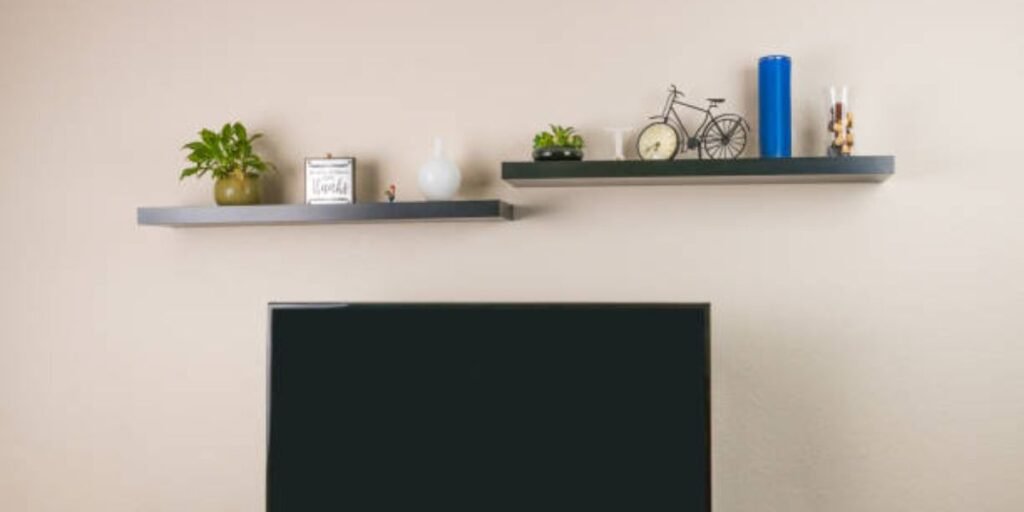
Large flat-screen televisions often dominate living rooms, creating a stark black void on an expansive wall. Floating bookshelves mounted above or flanking the screen soften the electronics and integrate the TV into the broader interior design.
Avoid crowding the screen by keeping shelves at least 8 to 12 inches away from the television’s frame. Keep the styling around media areas restrained, utilizing a balanced mix of books and muted decorative items to avoid creating visual clutter that distracts from watching TV.
11. Floating Bookcase in a Hallway
Narrow corridors and hallways are often left blank due to physical passage limits. Shallow floating shelves offer an effective storage solution without obstructing foot traffic.
To maintain safe passage, keep shelf depth strictly between 6 and 8 inches. This provides adequate depth for standard novels and trade paperbacks while ensuring shoulders and elbows will not catch on shelf corners.
Note: Position hallway shelves above elbow height, roughly 54 inches or higher from the floor, if depth exceeds 8 inches.
12. Minimalist White Floating Bookcase
When you paint floating shelves to match the exact paint shade and finish of the wall behind them, the physical structures visually recede. This architectural trick creates the illusion that books are hovering effortlessly in mid-air.
This approach lets the colorful book spines become the primary visual highlight of the room. It works remarkably well in small spaces or minimalist interiors where heavy wood tones might feel overpowering or visually cluttering.
13. Natural Wood Floating Bookcase
Unlike painted shelves that blend into the backdrop, natural hardwoods like oak, walnut, maple, or pine introduce rich organic texture and warmth to plain drywall.
Wood Type Selection Considerations:
– White Oak: Extremely durable, warm neutral tones, subtle grain.
– Black Walnut: Rich dark brown hues, premium luxury feel, high strength.
– Pine: Budget-friendly, rustic knot patterns, softer wood structure.
Select timber species and stains that harmonize with existing architectural details in the room, such as hardwood flooring, trim work, or major furniture pieces, rather than choosing a wood finish in total isolation.
14. Floating Bookcase With Hidden Supports
The defining characteristic of a true floating shelf is the total absence of visible metal brackets, diagonals, or external wall cleats. Achieving this seamless aesthetic requires specialized internal mounting hardware concealed within the body of the shelf itself.
Most designs utilize a thick steel mounting plate with extending solid steel rods welded perpendicular to the base plate. This plate mounts flush against the wall studs using heavy structural lag bolts. The shelf core, which features precisely bored matching holes in its rear edge, slides directly over the steel rods until it sits tight against the wall surface.
15. Floating Bookcase With a Picture Ledge Profile
A picture ledge shelf features a shallow depth combined with a thin, raised lip along the front edge, usually accompanied by a slightly sloped back base. This geometry prevents books resting face-forward from sliding off the front edge.
This setup works exceptionally well for showcasing rare collector editions, graphic novels, or children’s books. Picture ledges trade raw volume capacity for visual display, making them ideal for curated collections rather than dense reference storage.
16. Floating Bookcase With Decorative Objects
Filling every inch of a shelf with tightly packed books can make a room feel heavy and cluttered. Interspersing literary collections with curated decorative items creates visual breathing room and elevates the overall design.
Break up long rows of books by integrating structural, non-literary elements:
- Small potted trailing plants, such as pothos or succulents.
- Framed art prints or personal photography.
- Ceramic vases, decorative bowls, or sculptural stone objects.
- Framed spec sheets or unique antique artifacts.
Grouping objects in odd numbers, such as a cluster of three items featuring varying heights, yields a balanced composition.
17. Double Floating Bookcases on Either Side of a Sofa
Flanking a central sofa with twin sets of floating shelves creates clean, satisfying symmetry. This layout establishes a strong focal point along the main living room wall without the bulky mass of heavy floor-standing cabinets.
Match the shelf lengths, depths, wood finishes, and vertical spacing precisely on both sides of the sofa. Align the bottom shelves slightly above the height of the sofa’s back cushions to preserve head clearance for seated guests.
18. Floating Bookcase Beside a Doorway
The narrow slice of wall space situated between a door frame and an adjacent wall corner is frequently neglected. Custom-fitting short, stacked floating shelves into this narrow footprint creates valuable storage out of previously unusable space.
Measure door swing clearances carefully before installing shelf hardware. The shelf edge must not interfere with the door trim, door handle, or the path of the door when opened fully.
19. Full Wall of Floating Bookcases
Converting an entire architectural wall into a wall-mounted library offers maximum storage potential while maintaining an open, airy feel.
To prevent a full wall installation from overwhelming the space visually, maintain absolute consistency across shelf thickness, depth, material, and horizontal alignments. Let the varied colors and textures of the book spines provide the visual detail, keeping the shelf structure itself understated and uniform.
20. Floating Bookcase Designed Around Your Room
The most successful floating bookcase design responds directly to the specific architectural parameters of your space rather than following a rigid template.
Before purchasing materials or drilling holes, map out your project against six vital room factors:
How Much Weight Can a Floating Bookcase Hold?
Load capacity varies dramatically depending on structural factors. A poorly anchored decorative shelf might tear free from drywall under just 15 pounds, whereas a professionally engineered shelf anchored securely into wall studs can handle over 100 pounds per bracket.
A dense row of hardcovers weighs approximately 20 to 25 pounds per linear foot. Calculate the total intended weight of your book collection before selecting hardware, and always choose structural steel brackets fixed directly into wall studs.
Where Should You Mount a Floating Bookcase?
Optimal mounting locations balance convenience, room flow, and physical safety.
- Above a Sofa: Position the lowest shelf 12 to 15 inches above the top of the sofa backrest so seated occupants can lean back comfortably.
- Above a Desk: Maintain 20 to 24 inches of clear space between the desktop surface and the bottom shelf to accommodate computer monitors and task lamps.
- Beside a Bed: Mount shelves at least 12 inches to the side of the mattress boundary, or place them high enough to prevent accidental head impacts when sitting up.
- In a Corridor: Keep total shelf depth under 8 inches to maintain a clear walking path.
- In a Child’s Room: Keep primary display ledges between 18 and 36 inches from the floor for easy reach, while keeping sharp corners out of main play zones.
How to Make a Floating Bookcase Look Built-In
You can transform basic floating shelves into an architectural feature that looks custom-built for the room.
Match the shelf finish precisely to the surrounding trim work, or paint the shelves and the backing wall the exact same color. Extend shelf runs flush to adjoining corner walls, and align the shelf levels with nearby architectural elements like window casings, mantelpieces, or doorway trim.
Hiding all mounting brackets completely and maintaining tight, seamless joints against the wall surface yields a cohesive, high-end appearance.
Floating Bookcase vs. Traditional Bookcase
Both storage styles offer distinct functional and visual advantages depending on your room layout and storage needs.
| Feature | Floating Bookcase | Traditional Bookcase |
| Floor Footprint | Zero floor space required | Occupies permanent floor space |
| Visual Weight | Lightweight, open, and airy | Heavy, substantial, and solid |
| Space Suitability | Ideal for tight or small rooms | Best for large spaces with open walls |
| Installation | Requires precision wall anchoring | Freestanding, minimal assembly |
| Storage Capacity | Moderate to high capacity | Maximum density capacity |
| Mobility | Fixed once installed | Easy to relocate to new spots |
Choose floating bookcases when floor space is limited, when you want to keep a room feeling open, or when mounting directly to sound wall framing. Opt for traditional freestanding bookcases when you need maximum raw storage capacity or rent a home where drilling into studs is restricted.
Common Mistakes to Avoid
Installing wall-mounted shelves to hold heavy books requires careful planning. Avoiding key installation errors protects both your walls and your literary collection.
- Relying on plastic drywall anchors rather than anchoring directly into solid wood wall studs.
- Overlooking the total weight of paper and overloading thin or hollow-core shelves.
- Selecting overly deep shelves for narrow walkways or hallways.
- Leaving insufficient vertical height between shelf tiers for taller hardcover books.
- Installing long, unsupported shelf spans that sag over time.
- Placing shelves too high on the wall, making books difficult to reach or read.
- Mounting heavy, filled shelves directly over sleeping or seating areas without adequate structural supports.
How to Style Books on a Floating Bookcase
Styling bookshelves effectively is about striking a balance between structure, functionality, and visual warmth.
Mix vertical rows of books with short horizontal stacks, using the top book of a horizontal stack as a platform for a small decorative item. Leave open breathing space on every shelf tier rather than packing books tightly edge-to-edge. Group books by similar color tones or spine height if you prefer a clean look, but avoid over-styling to the point where the shelf stops looking like a functional library. Place your favorite, frequently read titles within easy reach on middle shelves, and keep heavy art books anchored on the bottom tiers.