

Homeowners are increasingly turning to solar energy, not just for environmental reasons, but as a calculated financial defense against volatile utility rates. Recent industry analysis indicates that residential solar adoption has reached a tipping point.
Data from 2026 shows that over 4 million U.S. households have successfully mitigated rising energy costs by transitioning to self-generation. The core question is whether this investment provides genuine financial security or if it remains a complex addition to your roof.
The answer is not a simple yes or no. A solar installation is a long-term infrastructure project. Its success depends entirely on your specific property, your current energy consumption, and the financial landscape of your local utility grid.
This guide breaks down the actual costs, the mechanics of how these systems function, and the realistic outcomes you should expect when choosing to install solar power.
What Is a Residential Solar System?
A residential solar system is not just a collection of panels. It is a complete electrical generation unit that integrates with your home. At its core, the system uses the photovoltaic effect to convert sunlight directly into electricity.
The primary components that make this possible include:
- Solar Panels (Photovoltaic Modules): These capture solar radiation and convert it into direct current (DC) electricity.
- Inverter: Because home appliances run on alternating current (AC), the inverter serves as the critical bridge, converting the DC power from the panels into usable household energy. Modern systems often use microinverters, which sit beneath each panel, to ensure that if one panel is shaded, it does not drag down the performance of the entire array.
- Mounting System: This provides the structural framework, typically attached to your roof or a ground-mount structure, engineered to withstand high wind and snow loads.
- Electrical Balance of System: This includes the wiring, circuit breakers, and safety switches that connect your array to your main electrical panel and the utility grid.
- Battery Storage: While optional, a battery system allows you to store excess energy for use at night or during power outages, providing a critical buffer when grid power is unstable.
Residential Solar System Cost in the USA
The financial barrier to entry is the primary concern for most homeowners. In the current market, the cost of a system is generally measured in dollars per watt ($/W).
A typical installed system cost in 2026 often falls within the range of $2.60 to $3.80 per watt. Before accounting for incentives, a standard medium-sized 8 kW home system often ranges from $16,000 to $20,000.
When considering these figures, keep in mind that larger systems often have a lower cost per watt due to economies of scale. Smaller systems, while cheaper overall, may have a higher price per watt because fixed costs like permits, engineering, and labor are spread across fewer panels.
What Drives the Cost of Solar Systems?
Pricing is rarely uniform. It is heavily influenced by variables specific to your site and your chosen equipment.
- System Size: Capacity is measured in kilowatts (kW). High-usage homes with heavy appliance loads or electric vehicle charging require larger arrays, which naturally command a higher price.
- Equipment Quality: Tier 1 panels and high-efficiency microinverters cost more upfront than entry-level components. This premium buys better degradation rates, meaning the system produces more power over the 25- to 30-year lifespan of the hardware.
- Roof Complexity: A simple, south-facing roof is significantly cheaper to equip than a roof with multiple pitches, dormers, or shading obstructions that require specialized racking or custom inverter configurations.
- Electrical Upgrades: If your home’s existing electrical service panel is outdated or lacks the necessary capacity to handle the solar feed-in, an upgrade is often required, adding a significant line item to your total project cost.
How Residential Solar Systems Save Money
Solar power provides a dual financial benefit by reducing your grid consumption and, in some jurisdictions, allowing you to export excess power back to the utility.
Your monthly savings are driven by how much of your own solar generation you consume directly. Every kilowatt-hour (kWh) you generate and use yourself is a kilowatt-hour you do not have to buy from the utility company at retail rates.
The average U.S. household consumes roughly 10,000 to 11,000 kWh annually. By generating a significant portion of this usage, households can see median annual savings between $1,000 and $2,000, depending on local utility rates and the specific net metering or net billing framework in your state.
When you generate more energy than your home requires, the excess is sent to the grid. Under net metering, you receive credits at the retail electricity rate, which can effectively reduce your electricity bill to nearly zero. In net billing environments, you are paid at a lower, fixed rate for exported energy.
This difference makes battery storage significantly more attractive in net billing states, as you can store your excess energy for use during peak hours when grid electricity is most expensive.
Payback Period: When Do You Break Even?
The payback period represents the time it takes for your cumulative energy savings to equal the initial investment cost. For most U.S. homes in 2026, the average break-even point occurs between 5 and 10 years.
Once the payback period is over, your solar system enters a phase where it is essentially providing free electricity for your household. Given that high-quality systems are rated to operate for 25 to 30 years, you are looking at more than a decade of near-zero energy costs after the system has paid for itself.
Factors that accelerate your payback include high local utility electricity rates, available state-level rebates, and the efficiency of your system design. Conversely, if utility rates are very low, your payback period may be on the longer end of the spectrum.
Residential Solar System Benefits
Beyond the direct reduction in your monthly utility costs, transitioning to solar energy offers several long-term structural and environmental advantages. It fundamentally changes how you interact with your utility provider and provides a level of financial predictability that conventional energy plans simply cannot match.
- Protection Against Energy Inflation: Electricity rates tend to rise consistently over time. When you install solar, you are essentially pre-paying for your electricity at today’s rates, effectively locking in your energy costs for the next 25 years.
- Increased Property Value: Homes equipped with owned solar systems are increasingly attractive to buyers. Studies frequently show that properties with solar installations sell faster and often command a higher price, as the new owners inherit a home with pre-established, reduced monthly operating costs.
- Energy Independence: While you may still be connected to the grid, generating your own power reduces your reliance on centralized utility providers. This shift gives you more autonomy over your household energy supply.
- Environmental Stewardship: Every kilowatt-hour you generate from the sun replaces energy that would otherwise be sourced from fossil fuel power plants. This significantly lowers your household carbon footprint and lessens your contribution to greenhouse gas emissions.
- Low Maintenance Load: Once installed, modern solar arrays have no moving parts. They require minimal upkeep, usually amounting to an occasional cleaning to remove debris and a professional system checkup every few years to ensure wiring and inverter performance remain optimal.
Types of Residential Solar Systems
Choosing the right architecture is critical because it dictates how your system interacts with the electrical grid and how you are protected during outages.
Grid-Tied Systems
This is the most common and cost-effective configuration for residential homes. The system is connected directly to the local utility grid. When your panels produce more power than you need, the excess is sent to the grid. When you need more power than you produce, you pull it from the grid as usual.
Crucially, these systems do not provide power during a utility outage for safety reasons, as they are designed to automatically shut down to prevent back-feeding electricity to lines that utility crews are attempting to repair.
Off-Grid Systems
These systems are entirely independent. They are designed for remote properties where grid access is either unavailable or prohibitively expensive to run. Because you have no grid as a backup, these systems require a significant investment in a battery bank to store energy for nighttime use and cloudy days. They often require a backup generator to ensure power continuity during extended periods of low sunlight.
Hybrid Systems
Hybrid systems are the fastest-growing segment of the market. They combine the financial efficiency of a grid-tied setup with the backup capability of battery storage. Under normal conditions, they operate like a grid-tied system, using solar power and potentially exporting excess to the grid.
If the grid fails, a hybrid inverter automatically detects the loss of power and isolates your home into a protected island, allowing your panels and batteries to keep your essential appliances running.
How Many Solar Panels Does a Home Need?
Sizing a system is not about guessing; it is a calculated process based on your actual energy consumption. The average American household consumes approximately 10,000 to 11,000 kWh of electricity annually.
To determine your needs, you divide your annual electricity usage by your area’s production ratio and then by the rated wattage of the chosen solar panels. Because production potential varies drastically between a sunny climate like Arizona and a more overcast region like the Pacific Northwest, there is no one-size-fits-all number.
Generally, homeowners looking to offset 100% of their usage can expect to install between 16 and 23 panels, assuming standard 430W to 450W modules.
The Installation Process Explained
A professional installation is a highly structured process designed to ensure safety and code compliance.
- Site Assessment: An installer evaluates your roof orientation, shading obstructions, and your historical energy bills. They use tools like LiDAR to map potential shade, ensuring the design maximizes your roof’s unique geometry.
- Engineering and Permitting: Engineers create technical plans, including structural load calculations to ensure your roof can support the panels. The installer handles the local building and electrical permits.
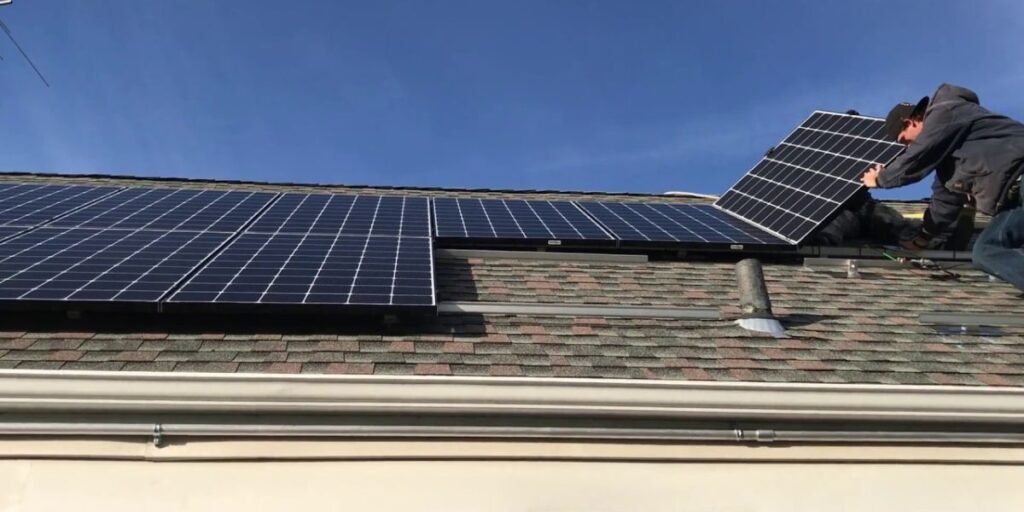
- Installation Day: Crews install the mounting brackets, secure the panels, and connect the inverter and monitoring hardware. For a standard residential roof, this physical installation typically takes 1 to 3 days.
- Inspection and Interconnection: After installation, a local building inspector verifies the work for safety. Finally, your utility company provides the “Permission to Operate,” allowing you to officially turn the system on and begin drawing credits.
Common Mistakes Homeowners Make
Many of the frustrations associated with solar ownership are entirely avoidable if you research the basics first.
- Ignoring Roof Health: Installing an expensive solar array on a roof that needs to be replaced in five years is a major error. Always address underlying roofing issues before mounting panels.
- Over- or Under-sizing: Oversizing can be a waste of capital if your utility does not offer full credit for excess production, while undersizing will leave you with higher-than-necessary monthly bills.
- Ignoring Incentives: While federal tax credits for direct ownership have shifted, always investigate local state rebates, utility incentives, or leasing programs that may still lower your costs.
- Leasing vs. Owning: Leasing a system may seem convenient, but it often sacrifices the long-term financial gain that comes from outright ownership, and it can sometimes complicate the process of selling your home later.
Summary
Deciding whether a residential solar system is worth the investment ultimately depends on your financial goals and your home’s physical potential.
For a standard 8 kW system costing roughly $20,000, you are essentially pre-paying for twenty-five years of electricity at today’s rates. By the time you reach your break-even point, typically between 5 and 10 years, you have transformed a recurring monthly liability into a productive capital asset.
When you weigh the average annual savings of $1,500 against the total cost, solar becomes more than just an environmental choice. It is a calculated hedge against energy inflation. If your roof is sound and your consumption justifies an array of this size, the math is overwhelmingly positive.
In 2026, the technology is reliable, and the financial framework is well-established, making solar one of the most practical and defensible home improvements you can make. It is not just about generating power. It is about securing your household against the unpredictability of the utility grid for the next two decades.
