

Creating an interior environment that feels fresh, elegant, and current without succumbing to short-lived decorating trends presents a constant challenge for modern homeowners. True interior design extends beyond surface-level aesthetics or seasonal color palettes. It involves a systematic understanding of spatial flow, architectural lighting, material durability, and the functional demands of everyday living.
Online portals such as DesignMode24 have become popular digital reference hubs for home styling, offering ideas across various room types and layout configurations. Exploring these concepts allows homeowners and design enthusiasts to test layout strategies and material combinations before making long-term financial commitments.
This comprehensive guide analyzes 15 creative interior design concepts, examining how each idea can be adapted to improve both the visual depth and practical utility of modern living spaces.
What Is DesignMode24 and How Can It Help With Interior Design?
DesignMode24 operates as an online informational portal focused on home decor, architectural inspiration, and practical interior styling guides. The platform provides room-by-room design breakdowns, color palette suggestions, lighting arrangement ideas, and space-planning strategies aimed at residential spaces.
Navigating these online resources helps homeowners visualize potential transformations, compare contrasting aesthetics, and identify functional layout improvements before purchasing furniture or altering structural elements.
It is important to distinguish between digital design inspiration sites and professional architectural or interior design consulting services. DesignMode24 provides general guidance, stylistic inspiration, and decor concepts. It does not offer custom engineering plans, structural building assessments, or direct procurement services. Using the site as a conceptual springboard enables homeowners to approach contractors or retail sourcing with a well-defined aesthetic strategy.
15 Creative Interior Design Ideas Worth Exploring
1. Warm Minimalism With Natural Wood and Soft Neutral Colors
Standard minimalism often receives criticism for feeling sterile or institutional when dominated by stark white paint, polished chrome, and unyielding geometric angles. Warm minimalism addresses this issue by merging uncluttered spaces and functional simplicity with organic materials, soft textures, and warm undertones.
Instead of stark whites and cool grays, the color base relies on creamy oats, warm taupe, soft beige, and muted ivory. Natural timber elements, such as white oak, light ash, or rich walnut, are introduced through floating shelving, dining tables, or exposed architectural beams to provide organic grounding.
Textiles play a critical role in preserving physical comfort within a minimalist layout. Bouclé fabrics, slubbed linen drapery, and woven wool rugs introduce tactile depth without cluttering visual space. Keeping horizontal surfaces mostly bare while selectively displaying a few handcrafted ceramic vessels or sculptural objects ensures the room retains an intentional, tranquil quality.
2. Earthy Color Palettes Featuring Olive Green, Clay, and Warm Brown
Color choices rooted in natural landscapes continue to replace cold cool-toned grays across residential interiors. Rich olive greens, terracotta clay, deep ochre, and warm espresso browns bring a sense of stability and quiet sophistication to living areas, bedrooms, and custom kitchen cabinetry.
When planning an earthy color scheme, spatial balance is essential to prevent rich tones from visually overwhelming a small room:
- Establish a dominant neutral background covering roughly 60% of the space, such as warm plaster or soft beige walls.
- Integrate secondary earthy tones across 30% of the room through major upholstered furniture, built-in cabinetry, or large area rugs.
- Use deeper mineral shades for the remaining 10% as deliberate accents on throw cushions, ceramic art, or window trim.
Evaluating paint samples under both direct daytime sunlight and warm evening artificial light is necessary, as rich organic pigments shift dramatically across different light conditions throughout the day.
3. Sculptural Furniture That Combines Comfort With Visual Interest
Introducing furniture defined by sweeping curves, rounded silhouettes, and organic forms breaks up rigid, boxy room architectures. Curved sectional sofas, circular coffee tables, barrel-back lounge chairs, and kidney-shaped desks add visual movement while softening sharp wall angles.
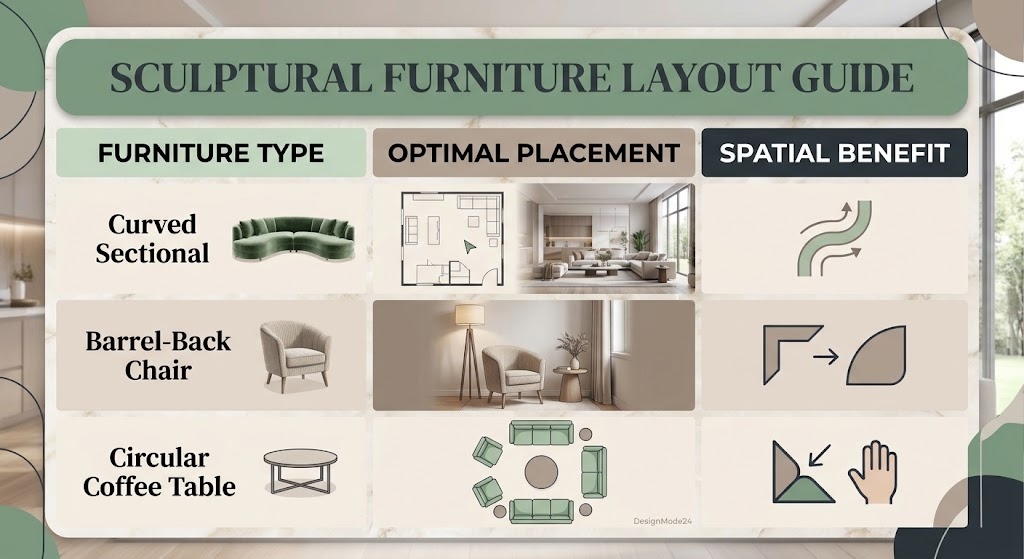
Floor clearance and walking paths must take priority when placing sculptural pieces. A curved sofa should be positioned with ample perimeter clearance so its silhouette can be appreciated from multiple viewpoints without blocking entryways or architectural pathways.
4. Layered Lighting With Pendants, Wall Lights, and Table Lamps
Relying on a single central overhead lighting fixture flattens a room’s visual dimensions, casts harsh downward shadows, and fails to accommodate different daily activities. A well-designed lighting scheme integrates three distinct lighting layers: ambient (overall room illumination), task (focused light for reading or cooking), and accent (highlighting architectural details or artwork).
Ambient lighting provides overall room visibility through recessed ceiling fixtures or central flush-mounts. Task lighting introduces focused, functional light where work occurs, such as under-cabinet LED strips in kitchens or adjustable brass desk lamps on office workspaces. Accent lighting, including wall-mounted sconces, picture lights, and low-level table lamps, adds atmospheric warmth and visual depth.
Using LED bulbs with a warm color temperature between 2700K and 3000K prevents residential spaces from feeling like commercial environments. Installing wall-mounted dimmer switches across all main lighting circuits allows homeowners to adjust illumination levels from functional daytime utility to relaxed evening entertaining.
5. Textured Walls With Limewash Finishes, Decorative Plaster, and Wood Slats
Flat, painted drywall can leave expansive rooms feeling featureless. Applying specialized wall treatments introduces subtle movement, architectural depth, and physical texture without relying on busy wallpaper patterns or heavy decorative trim.
- Limewash Finishes: Formulated from slaked lime and natural pigments, limewash creates a soft, chalky, matte surface with subtle tonal variations. It works particularly well in bedrooms, dining areas, and calm sitting rooms.
- Venetian Plaster & Microcement: These smooth, trowel-applied plaster finishes yield a stone-like surface with subtle sheen variations. Microcement provides a seamless, water-resistant surface suitable for wet areas like bathrooms and kitchen backsplashes.
- Acoustic Wood Slats: Vertical timber slat panels backed by acoustic felt add warm linear texture while absorbing sound reverberation in open-plan living zones, hallways, and home theaters.
6. Biophilic Interior Design With Natural Materials and Indoor Plants
Biophilic design principles focus on deepening the connection between indoor environments and the natural world. Incorporating abundant daylight, raw stone surfaces, unvarnished wood, and living foliage improves indoor air feel and overall daily well-being.
Integrating indoor plants successfully depends on matching specific plant light requirements to actual window orientations. Low-maintenance species like Snake Plants, ZZ Plants, and Cast Iron Plants thrive in dimmer entryways or north-facing rooms, whereas Fiddle Leaf Figs, Bird of Paradise, and Monstera varieties require bright, indirect light near south- or west-facing windows.
Maximizing natural daylight by keeping window treatments minimal or using sheer linen drapery strengthens the connection to outdoor views. Pairing plant displays with woven jute rugs, unpolished marble trays, and raw wooden bowls reinforces a grounded, tactile atmosphere.
7. Space-Saving Furniture and Multifunctional Rooms for Modern Homes
Compact floor plans and remote work setups frequently require individual rooms to serve multiple distinct purposes throughout the day. Dual-purpose furniture designs allow living spaces to shift easily between work, dining, and evening relaxation.
Extendable dining tables accommodate quiet family meals while expanding to seat larger groups for weekend gatherings. Lift-top coffee tables and storage ottomans conceal extra throw blankets, games, and work electronics completely out of sight. Wall-mounted drop-leaf desks or slim console tables convert unused hallway nooks or living room corners into functional daytime workstations without permanently taking up floor space.
8. Personalized Interiors With Vintage Furniture and Contemporary Pieces
Rooms outfitted entirely with brand-new, mass-produced items can feel impersonal or like retail showrooms. Combining contemporary furniture with vintage antiques, family heirlooms, and original artwork creates a rich, layered interior that reflects personal history.
Achieving visual harmony when mixing different eras relies on unifying design elements, such as repeating a key wood finish or maintaining a consistent color palette throughout the space. Placing a mid-century wooden side table next to a streamlined modern sofa creates an engaging visual contrast. Displaying personal travel artifacts, vintage ceramics, or original oil paintings alongside modern lighting keeps the overall aesthetic authentic and anchored.
9. Statement Stone, Travertine, and Natural-Looking Surface Finishes
Natural stone surfaces bring timeless texture and visual weight into modern interiors. Dramatically veined marbles, warm porous travertines, and soft limestones elevate bathroom vanities, fireplace surrounds, and kitchen islands.
Travertine works exceptionally well for coffee table tops, mantle accents, and wall tiles due to its warm cream tones and subtle surface pitting. Veined marble serves as a dramatic focal point when applied across kitchen island waterfall edges or full-height backsplash slabs. For high-use kitchen counters where stain resistance is critical, engineered quartzites or composite stone materials offer the appearance of natural marble alongside superior scratch and stain resistance.
10. Curated Gallery Walls and Oversized Artwork
Artwork anchors a room’s thematic direction, balances spatial scale, and pulls together accent colors from surrounding furnishings. Whether featuring a single massive statement canvas or a carefully aligned gallery grouping, proper placement transforms plain walls into intentional focal points.
Single focal artworks should be mounted so the vertical center of the piece sits approximately 56 to 60 inches from the floor, positioning the canvas directly at average human eye level. When hanging artwork above a sofa, credenza, or headboard, the frame width should span roughly two-thirds of the furniture piece’s total length. Multi-frame gallery walls maintain visual order when uniform frame finishes and consistent 2-to-3-inch gaps are maintained between adjacent frames.
11. Contemporary Kitchen Design With Functional Storage and Integrated Lighting
Modern kitchen planning prioritizes clear work surfaces, efficient workflows, and organized internal cabinetry over purely decorative exterior detailing.
- Install full-extension deep drawers, vertical tray dividers, and dedicated pull-out appliance garages to keep daily clutter off main counter surfaces.
- Mount continuous LED channel strips beneath upper wall cabinets to provide bright, shadow-free task illumination across preparation counters.
- Choose non-porous quartz surfaces and seamless slab backsplashes to reduce grout line maintenance and ensure long-term durability.
12. Spa-Inspired Bathrooms With Natural Textures and Warm Lighting
Residential bathrooms are increasingly designed as calm wellness retreats focused on relaxation and daily restoration rather than purely utilitarian tasks.
Combining large-format stone-look porcelain tiles with matte black or brushed bronze plumbing fixtures creates a clean, hotel-inspired setting. Backlit vanity mirrors and indirect recessed cove lighting offer soft, glare-free illumination during early morning or late evening hours. Installing high-efficiency, ultra-quiet exhaust ventilation protects wooden vanities, plaster wall finishes, and mirrors from excess humidity accumulation.
13. Layered Textiles With Linen Curtains, Textured Rugs, and Upholstery
Fabrics provide essential sound absorption, physical softness, and visual warmth across hard tile or hardwood flooring. Layering various textile weights—such as heavy wool area rugs, sheer linen drapery, smooth leather seating, and plush cotton accent pillows—adds depth to any room.
Area rugs should be sized generously so that at least the front legs of major seating pieces rest comfortably on the rug border, visually binding the conversational grouping together. Mounting floor-length drapery rods close to the ceiling line rather than immediately above the window frame draws the eye upward, making ceilings feel higher. Selecting performance fabrics with stain-resistant coatings ensures high-use living room seating stands up to daily household activity.
14. Color-Drenched Rooms and Coordinated Tonal Interiors
Color drenching involves painting walls, baseboards, window casings, doors, and occasionally ceilings in a single paint color or subtle shade variations of the same hue. This continuous application softens traditional boundary lines, creating an immersive atmosphere that can make compact rooms feel surprisingly open.
Deep forest greens, rich navies, dusty terracottas, and warm ochres are particularly well suited for this technique. Varying the paint sheen provides subtle textural contrast; a matte or eggshell finish works well on main wall expanses, while satin or semi-gloss adds durability to doors and trim work. Balancing these saturated surfaces with warm wooden furniture and warm metal lighting accents prevents the room from feeling overwhelming.
15. Sustainable Interior Design Through Durable Furniture and Reused Materials
Sustainable design centers on longevity, quality craftsmanship, and conscious consumer choices. Moving away from fast-furniture trends, sustainable decorating prioritizes solid construction, vintage sourcing, and repairable materials.
Investing in solid hardwood frames and high-resilience cushions ensures furniture can be reupholstered and enjoyed for decades. Sanding down and restaining vintage wooden sideboards or updating secondhand dressers with fresh paint and solid brass hardware reduces landfill waste while adding unique character. Choosing zero-VOC paints, natural fiber wool rugs, and sustainably harvested timber protects indoor air quality and supports responsible manufacturing.
How to Bring These Interior Design Ideas Into Your Home
Transitioning from design inspiration to a completed room requires a practical, step-by-step methodology:
- Identify Room Function: Determine primary daily uses, household traffic patterns, and necessary furniture requirements before making aesthetic decisions.
- Measure Spatial Clearances: Draft a clear floor plan detailing wall lengths, ceiling heights, door swings, window positions, and electrical outlet locations to ensure proper furniture sizing.
- Establish a Cohesive Palette: Choose a primary neutral foundation, one or two secondary complementary shades, and consistent metal or wood finishes to maintain visual harmony throughout the home.
- Plan Layered Lighting Early: Position outlets, switches, and hardwired fixtures during the initial planning phase rather than treating lighting as an afterthought.
- Set a Balanced Budget: Direct primary investment toward high-use core pieces like sofas, mattresses, and dining tables, allocating secondary funds for accent decor and paint updates.
Budget-conscious updates can transform a space without full structural renovations. Replacing outdated cabinet handles, rearranging existing furniture for improved flow, introducing fresh lampshades, updating accent pillow textiles, or painting a single architectural feature can immediately elevate a home’s atmosphere.
Online platforms like DesignMode24 offer helpful inspiration, but every design concept should ultimately be evaluated against your specific floor plan, daily routine, maintenance expectations, and budget.
Conclusion
The most effective interior design choices balance aesthetic appeal with everyday practical function. While decorating trends offer fresh inspiration, successful home styling relies on appropriate spatial proportions, good lighting, durable materials, and thoughtful alignment with the daily habits of those living in the space.
Resources like DesignMode24 serve as accessible tools for exploring creative decor ideas and visualizing layout possibilities. Evaluating these concepts against your specific floor plan, budget, and lifestyle requirements allows you to build a comfortable, functional, and stylish home environment built for long-term enjoyment.
Frequently Asked Questions
What Is DesignMode24 in Interior Design?
DesignMode24 is an online resource providing home decorating concepts, room styling guides, layout tips, and practical home improvement inspiration. It functions as a digital inspiration platform rather than a custom interior architecture or design firm.
What Interior Design Ideas Can You Explore Through DesignMode24?
The site covers room-by-room design topics, including living room seating arrangements, kitchen storage solutions, bedroom color palettes, modern bathroom lighting schemes, small-space organization, and seasonal home decor trends.
What Interior Design Trends Are Worth Considering in 2026?
Key long-term design approaches include warm minimalism, biophilic design elements, earthy color palettes (olive green, terracotta, warm brown), sculptural rounded furniture, layered lighting schemes, and sustainable, durable materials.
How Can You Update Your Home’s Interior Design on a Budget?
Cost-effective ways to refresh a space include rearranging existing furniture for better circulation, applying fresh wall paint, replacing cabinet hardware and switch plates, adding indoor plants, updating throw blankets and cushions, and introducing layered floor lighting.
How Do You Choose Interior Design Ideas for a Small Home?
For smaller floor plans, focus on scaled furniture, multifunctional pieces (like storage ottomans or fold-out desks), vertical wall-mounted shelving, clear walking paths, strategically placed mirrors to reflect light, and a cohesive, light-toned color scheme.
